
As the vibrant colors of autumn begin to paint the streets of Teaneck and temperatures start their gradual descent, homeowners throughout our community are preparing their properties for the changing season. While most residents focus on raking leaves, cleaning gutters, and servicing their heating systems, there's one crucial aspect of home maintenance that often gets overlooked: your home's security and lock systems. The transition from summer to fall presents the perfect opportunity to conduct a comprehensive security audit of your home, ensuring that your locks, keys, and security measures are functioning optimally before winter arrives. At Teaneck Locksmith Services, located at 718 Teaneck Rd, we've created this essential fall locksmith checklist to help you protect what matters most.
Why Fall is the Perfect Time for a Security Audit
Fall represents a transitional period that brings unique security challenges to Teaneck homes. As daylight hours shorten and darkness arrives earlier each evening, opportunistic burglars find more cover for their activities. Statistics consistently show that property crimes tend to increase during the fall and winter months, making this the ideal time to strengthen your home's defenses.
The changing weather conditions also take a toll on your locks and security hardware. Summer's humidity gives way to fall's temperature fluctuations, which can cause metal components to expand and contract, potentially leading to misalignment, sticking, or complete lock failure. Additionally, as leaves fall and debris accumulates, outdoor locks and security features can become compromised by environmental elements.
This season also marks the return to regular routines after summer vacations. Children are back in school, work schedules normalize, and families settle into predictable patterns. This regularity, while comforting, can also create security vulnerabilities if proper precautions aren't taken. Conducting a thorough locksmith inspection now ensures your home remains secure throughout the upcoming holiday season when package theft and home break-ins typically spike.
Inspect All Entry Point Locks
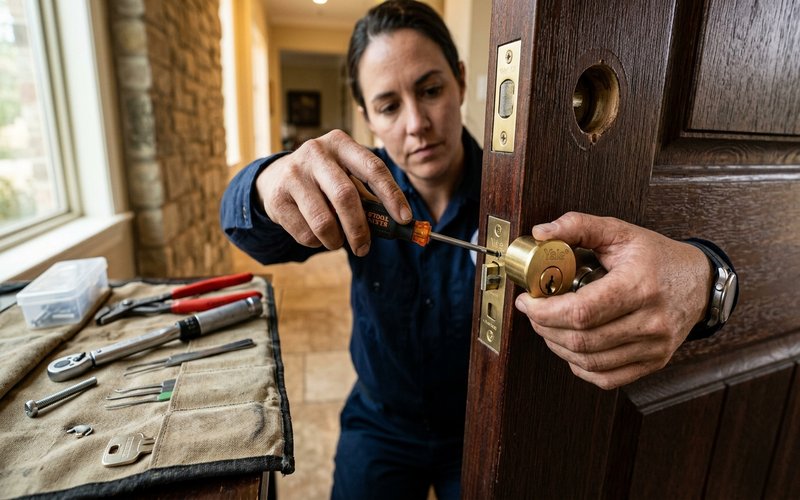
Your home's entry points are the first line of defense against unauthorized access, making them the most critical component of your fall security checklist. Begin by systematically examining every lock on every door that provides access to your home, including front and back doors, side entrances, garage doors, and basement access points.
Test each lock's functionality by inserting and turning the key multiple times. The action should be smooth and effortless. If you notice any resistance, grinding, or difficulty turning the key, this indicates internal wear or debris accumulation that needs addressing. Don't ignore these warning signs—a lock that's difficult to operate today could fail completely tomorrow, potentially leaving you locked out in cold weather or, worse, unable to secure your home.
Examine the strike plates on each door frame. These metal plates should be securely fastened with screws at least three inches long, penetrating deep into the door frame's studs. Short screws offer minimal resistance to forced entry. If your strike plates are loose or secured with inadequate hardware, upgrading them is a simple yet highly effective security enhancement.
Check the deadbolts on all exterior doors. Every external door should have a quality deadbolt with at least a one-inch throw. Test the deadbolt's extension to ensure it fully engages the strike plate. Examine the bolt itself for signs of wear, and verify that the lock cylinder shows no signs of tampering or damage. If any of your doors lack deadbolts, fall is the perfect time to have them installed before winter weather makes the job more challenging.
Evaluate Door Hardware and Integrity
Even the most sophisticated locks provide inadequate security if the doors themselves are compromised. Conduct a thorough inspection of each door's physical condition, paying special attention to wooden doors that may have experienced warping or swelling during the humid summer months.
Push firmly against each closed and locked door to test its stability within the frame. Excessive movement indicates loose hinges, a poorly fitted door, or a weakened frame—all of which compromise security. Check all hinge screws to ensure they're tight and properly seated. For enhanced security, consider replacing standard hinge screws with longer security screws that anchor deeper into the wall studs.
Inspect the door frames for signs of rot, damage, or deterioration, particularly around the lock and strike plate areas. Wood rot is especially common in Teaneck's climate and can significantly weaken your door's resistance to forced entry. Any soft spots or visible damage should be repaired immediately and the wood treated to prevent further deterioration.
For homes with glass panels near door locks, assess whether someone could easily break the glass and reach through to unlock the door from inside. If this vulnerability exists, consider installing double-cylinder deadbolts that require a key from both sides, or explore glass break sensors as part of a comprehensive security system.
Address Sticky Locks Before Winter
Fall's moderate temperatures provide the ideal window for addressing sticky or difficult locks before winter's freezing conditions exacerbate the problem. Locks that operate sluggishly now will only worsen when temperatures drop, potentially leaving you struggling with frozen mechanisms during Teaneck's coldest months.
The most common cause of sticky locks is accumulated dirt, dust, and debris within the lock cylinder. Never use oil-based lubricants like WD-40 in locks, as these products attract more dirt and can gum up the internal mechanisms. Instead, use a graphite-based lubricant or dry silicone spray specifically designed for locks. Insert the applicator nozzle into the keyway and apply a small amount, then insert and remove your key several times to distribute the lubricant throughout the mechanism.
If lubrication doesn't resolve the issue, the problem may stem from worn internal components, a damaged key, or misalignment between the lock and strike plate. Worn keys are particularly problematic—if your key shows visible wear, has rough edges, or doesn't insert smoothly, have duplicates made before the original becomes too damaged to copy. Always have keys duplicated from the original rather than from copies, as each generation of duplication introduces minor imperfections that can affect performance.
For locks that remain problematic despite cleaning and lubrication, professional evaluation is warranted. Sometimes the most cost-effective solution is simply replacing an old, worn lock with modern hardware that offers both improved functionality and enhanced security features.
Rekey Your Locks if Circumstances Have Changed
Fall presents an excellent opportunity to consider whether your home's lock security has been compromised by changing circumstances over the past year. Rekeying involves altering the lock's internal configuration so that old keys no longer work, while new keys are provided to you. This process is typically more economical than complete lock replacement and can be completed quickly by professional locksmiths.
Consider rekeying if you've recently moved into your home, even if it was several months ago. You can never be certain how many copies of the original keys exist or who might have access to them. Previous owners, their family members, contractors, real estate agents, and house cleaners may all have had keys at various points.
If you've ended relationships with service providers who had keys to your home—such as housekeepers, landscapers, pet sitters, or contractors—rekeying ensures they no longer have access. Even if you trust these individuals completely, keys can be lost or stolen without their knowledge, potentially falling into the wrong hands.
Lost or stolen keys represent an obvious security concern that necessitates rekeying. If you cannot account for all copies of your house keys, assume someone else might have access and take appropriate action. The relatively small investment in rekeying provides immeasurable peace of mind.
Rekeying is also advisable if you've experienced a break-in or attempted break-in, as criminals sometimes return to properties they've successfully targeted or attempted to access. Additionally, if you've had tenant turnover in a multi-family property or if your teenage driver has lost car keys that were attached to house keys, rekeying should be a priority.
Upgrade to High-Security Lock Systems
Fall home improvement projects aren't limited to aesthetic updates—investing in your home's security infrastructure provides lasting value and protection. If your home still uses basic builder-grade locks installed when the house was constructed, you're likely relying on minimal security that sophisticated criminals can easily bypass.
High-security locks offer numerous advantages over standard residential locks. They feature pick-resistant and drill-resistant cylinders that make unauthorized entry significantly more difficult. Many incorporate patented keyway designs that prevent unauthorized key duplication—keys can only be copied by authorized dealers with proper credentials, giving you complete control over who has access to your home.
Consider upgrading to locks that have earned high ratings from independent testing organizations. Look for Grade 1 certification from the American National Standards Institute (ANSI), which represents the highest level of security for residential locks. These locks undergo rigorous testing for durability, strength, and resistance to attack.
For homeowners interested in combining traditional security with modern convenience, smart locks offer compelling advantages. These systems allow you to lock and unlock doors remotely via smartphone, create temporary access codes for guests or service providers, and receive notifications when doors are accessed. Many integrate seamlessly with whole-home security systems and other smart home devices.
When upgrading locks, ensure all exterior doors receive equal attention. Criminals always target the path of least resistance—a high-security front door offers little protection if your back or side door uses a basic lock that can be defeated in seconds.
Secure Sliding Doors and Windows
While traditional swinging doors typically receive the most security attention, sliding glass doors and windows represent common vulnerability points that criminals frequently exploit. These entry points require specific security measures that differ from standard door locks.
Sliding glass doors, popular in many Teaneck homes for their aesthetic appeal and natural light, often have inadequate factory-installed locks. The standard latch mechanisms can be easily lifted off their tracks or forced open with sufficient pressure. Enhance sliding door security by installing a security bar or Charlie bar in the track, which physically prevents the door from opening even if the lock is compromised. For a more sophisticated solution, consider installing a pin lock that secures the sliding panel to the frame, or upgrade to a keyed sliding door lock that offers significantly more resistance than standard latches.
Examine all sliding doors to ensure they cannot be lifted from their tracks. Most modern sliding doors have anti-lift devices, but older installations may lack this feature. Simple anti-lift brackets can be installed at the top of the door frame to prevent this common bypass technique.
Windows, particularly ground-floor and basement windows, require equal security attention. Test all window locks to ensure they engage properly and hold the window securely closed. Window locks often become painted over or corroded, rendering them ineffective. Replace any damaged or non-functioning window locks before winter, when closed windows need to maintain both security and energy efficiency.
For windows that open vertically, install window pins or keyed locks that prevent the window from being opened more than a few inches. This allows for ventilation while maintaining security. Basement windows, which are particularly vulnerable due to their concealment and low visibility, benefit from the addition of window well covers or security bars.
Check Outdoor Lighting and Visibility
As fall brings earlier sunsets and longer periods of darkness, proper outdoor lighting becomes increasingly important for home security. Well-designed lighting eliminates the shadows and dark corners that criminals prefer when attempting unauthorized entry.
Walk around your property at night to identify areas of darkness that could provide cover for criminal activity. Pay particular attention to entry points, side yards, backyards, and any areas where valuable items are stored. These zones should be well-lit during evening hours.
Motion-activated security lights offer an excellent balance of energy efficiency and security effectiveness. These lights remain off until motion is detected, then illuminate suddenly—an unexpected activation that typically startles and deters would-be intruders while alerting homeowners to activity around their property. Install motion lights at all exterior doors, in driveways, and along pathways to your home.
Consider the height and angle of your security lighting. Lights positioned too low can be easily unscrewed or disabled by intruders. Mount fixtures at least eight to ten feet high where possible, and consider tamper-resistant designs for critical locations.
For homes with significant landscaping, trim back any shrubs or tree branches that have grown over the summer and now obstruct lights or create hiding spots near windows and doors. Overgrown vegetation provides concealment for criminals and blocks the natural surveillance that serves as a powerful deterrent.
Modern smart lighting systems allow you to control outdoor lights remotely, creating the appearance of occupancy even when you're away. Lights that can be programmed to turn on and off at varying times appear more natural than those operating on fixed schedules, making them more effective at deterring crime.
Maintain and Test Garage Security
Garages represent a frequent target for criminals and a common point of home entry, yet they often receive insufficient security attention. A comprehensive fall security check must include thorough evaluation of your garage's locks, doors, and overall security measures.
If your garage has a side door providing direct access from outside, ensure it's secured with the same quality lock and deadbolt you'd use on your home's primary entrance. Many garage side doors have minimal locks that can be easily compromised. Never leave this door unlocked, even when you're home—it provides direct access to your garage and potentially to your home's interior.
Test your garage door opener's functionality and ensure the access code hasn't been left at the default setting established by the manufacturer. Default codes are often publicly available and can be easily discovered by criminals. Change your code to a unique combination and avoid obvious choices like birth years or house numbers.
Inspect the door connecting your garage to your home's interior. This door should be treated as an exterior door in terms of security, with a solid core construction and a quality deadbolt lock. Many homeowners neglect this door's security because it's accessed through the garage, but if someone gains garage access, this door becomes their target.
For homes with automatic garage door openers, verify that the emergency release mechanism isn't accessible from outside the closed door. Criminals have developed techniques to trip these releases using wire coat hangers or other tools inserted under garage doors. Consider adding a zip tie or release guard that prevents unauthorized activation while still allowing emergency use from inside.
Ensure windows in your garage have curtains or frosting that prevents outsiders from seeing inside. Visible lawn equipment, tools, bicycles, and cars advertise your belongings to potential thieves and allow them to determine when you're home based on whether your vehicles are present.
Create and Distribute Emergency Access Plans
Fall is an ideal time to establish or update your family's emergency access plans and ensure that trusted neighbors or family members can access your home if necessary. As winter approaches with its potential for severe weather, having reliable backup access becomes increasingly important.
Consider whether your current spare key storage method provides adequate security. Keys hidden under doormats, in fake rocks, or above door frames are the first places criminals check. If you must store a spare key outside, invest in a high-quality lock box with a combination code, mounted in a discrete location.
A more secure alternative involves leaving a spare key with a trusted neighbor or nearby family member. Choose someone who's typically home during the day and who you can contact easily if you need access. Make this a reciprocal arrangement so both households have backup access in emergencies.
Ensure all family members know what to do if they're accidentally locked out. Children especially should understand they should never attempt to break into the house or open windows if they've forgotten their keys. Establish clear protocols—perhaps calling a parent at work or going to a specific neighbor's home—and ensure everyone has the necessary phone numbers memorized or stored in their devices.
For families with elderly relatives or those with medical conditions, consider installing a lockbox system that emergency responders can access. These systems can be critically important if paramedics need to enter your home quickly but you're unable to open the door.
Schedule Professional Lock Maintenance
While many lock maintenance tasks can be handled by homeowners, professional locksmith services provide expertise and capabilities that DIY approaches cannot match. Fall represents the perfect time to schedule a professional security consultation before winter weather and holiday activities make scheduling more challenging.
Professional locksmiths can identify vulnerabilities you might overlook and recommend security solutions tailored to your home's specific architecture and your family's needs. We examine not just your locks but your entire security ecosystem, considering how different elements work together to protect your property.
A professional lock service includes deep cleaning and lubrication of all lock mechanisms using specialized tools and products. We can also identify internal wear that isn't yet causing obvious problems but will likely lead to failure in the near future, allowing you to address issues proactively rather than dealing with emergency lockouts.
Professional locksmiths stay current with the latest security technology and can introduce you to solutions you might not know exist. From smart locks to keyless entry systems to integrated home security platforms, we can explain the advantages and limitations of various options and help you make informed decisions about upgrades.
For homes with high-security locks or complex security systems, professional maintenance ensures everything operates as designed.